Not Everything Can Be Fixed With a Restart
Fifteen years of living with type 2 diabetes, two hospital scares and now a serious foot ulcer. At 45, I'm finally realising that looking after myself can't wait.
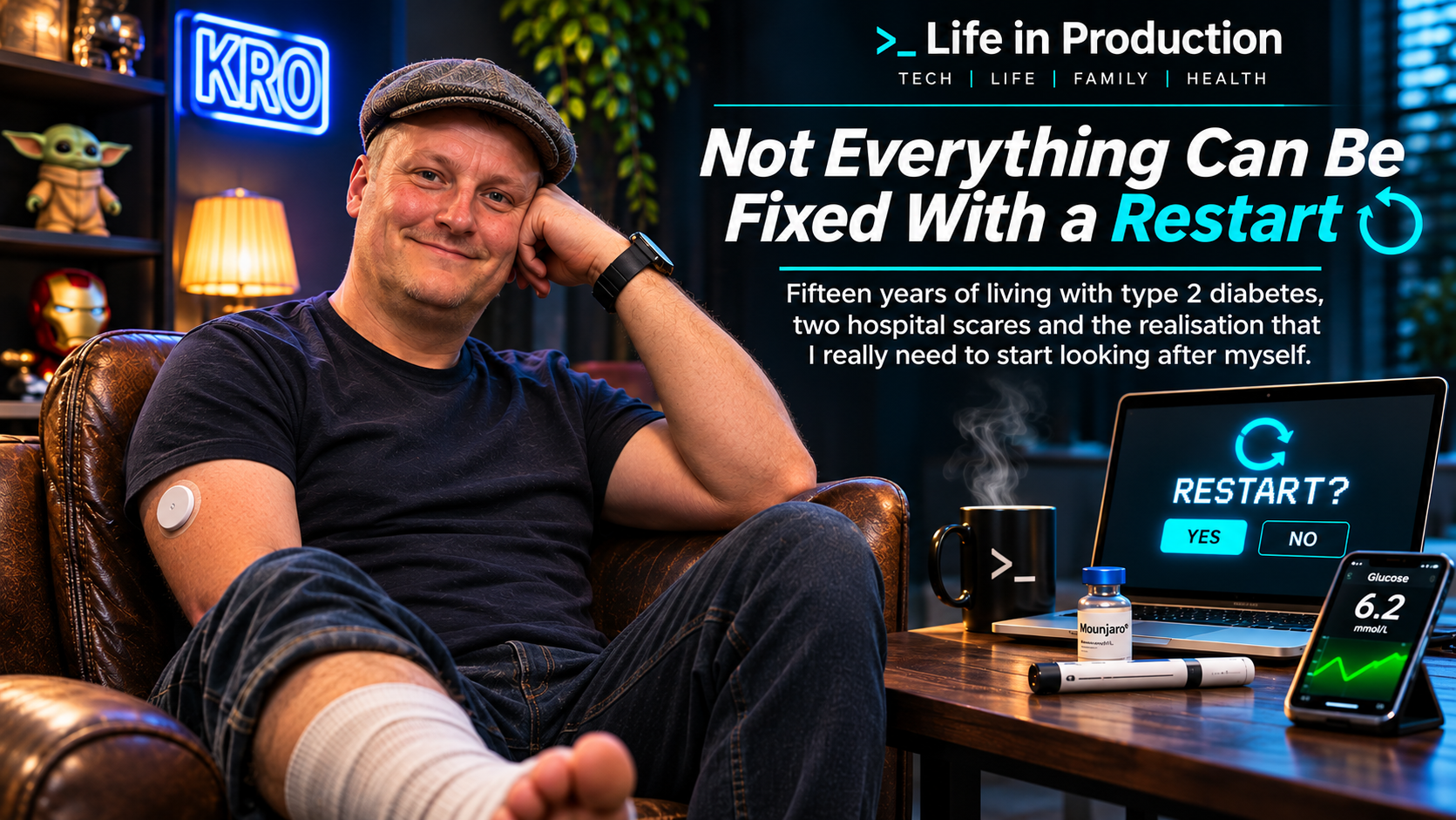
Fifteen years of living with type 2 diabetes, a few serious warning signs, and the realisation that I really need to start looking after myself.
I work in IT. A fair amount of my working life involves dealing with things that aren't working as they should.
Servers, networks, applications. There's normally a log to investigate, a warning to look at or, occasionally, something that just needs switching off and back on again.
Unfortunately, the human body doesn't come with a restart button. And after 15 years of living with type 2 diabetes, I'm beginning to realise I've probably spent far too much time wishing it did.
It Won't Happen to Me
Back in 2011, I was diagnosed with type 2 diabetes.
It shouldn't really have come as a surprise. My mum, dad and gran all had type 2 diabetes. You could say it ran in the family.
But typical me, I never thought I'd get it.
I'd been feeling increasingly thirsty and making more trips to the toilet, particularly during the night. My mum had some urine testing strips at home, so I decided to give one a go.
The result was practically off the chart.
A phone call to the doctors later, and I was officially a diabetic.
I was shocked, but at the same time, not particularly shocked. I knew the family history, but somehow thought I'd be the exception.
Looking back, that was probably the beginning of what became a recurring theme in my life: burying my head in the sand and hoping things would sort themselves out.
I started taking Metformin and was told I needed to lose weight. I even joined Slimming World with my mum.
It was a start, but unfortunately, it didn't last.
My Own Personal Pharmacy
Over the following years, the medication gradually increased.
I think it was around two years after being diagnosed that I started taking insulin.
There's one small problem with that. I hate needles.
Not ideal when you're diabetic and regular blood tests and injections become part of everyday life.
I started with a once-daily long-acting insulin. Eventually, Victoza was added, followed by rapid-acting insulin with meals.
These days, I sometimes feel like I have my own pharmacy.
But there's something I need to admit.
For years, I was terrible at managing my diabetes. I didn't regularly monitor my blood sugar, I'd miss injections, and sometimes I'd go days without taking my medication.
Not because I didn't know I should. I just kept thinking everything would somehow be fine.
Unfortunately, it wasn't.
When Things Got Seriously Wrong
Twice I've ended up in hospital because things got dangerously out of control.
The first time, I was working away in Suffolk.
I'd travelled up on the Monday feeling unwell, but I had a cold and assumed that was all it was.
Over the next few days, things got progressively worse.
I was struggling to stay awake during the working day. I'd return to my hotel room and collapse onto the bed, completely exhausted.
Eventually, getting out of bed became a struggle. Then my breathing became difficult. I was gasping for air.
I called NHS 111 for some advice.
The next thing I knew, the hotel manager was opening my room door and paramedics were coming through it.
It was blue lights all the way to hospital.
I spent hours in A&E on drips, being closely monitored, followed by several days in hospital before I was well enough to go home.
You'd think that would have been enough of a warning.
Apparently not.
The second time was arguably even more frightening.
I was hallucinating, having conversations with people who weren't actually there.
My partner at the time took me to hospital. Not just any hospital, but the very hospital where I happened to work.
I spent several days on a ward, being given some very serious conversations about my condition and just how close I'd come to a potentially fatal cardiac arrest.
Yet somehow, even after those experiences, I still struggled to take proper control of my health.
A Different Kind of Restart
In 2022, my personal life changed significantly.
After an 11-year relationship, I separated from my partner and moved out.
We have four children together, and life had always been incredibly busy. Between work, family responsibilities and the children's additional needs, I often felt there was very little time left for myself.
I'm not using any of that as an excuse. But it was the reality of how life felt at the time.
The separation gave me an opportunity to reassess things.
Towards the end of 2022, I spoke to my diabetes nurse about attending an insulin education programme.
I signed up for the next Saturday online course and spent ten weeks learning about nutrition, how different foods affect blood glucose and how to manage my condition properly.
Something finally started clicking.
I requested FreeStyle Libre glucose sensors, giving me readings on my phone and alerts when things weren't going quite as planned.
Mounjaro also became part of my treatment journey, helping with blood sugar management and weight loss.
For the first time in years, I felt I was beginning to understand what I needed to do.
These days, my glucose readings are generally in the green, or occasionally creeping into the yellow.
Although I've also discovered the joys of going too far in the other direction.
There's nothing quite like waking up at three in the morning with low blood sugar and reaching for one of the kids' cartons of orange juice.
Living the dream.
Getting Back to Enjoying Life
The years following my separation weren't particularly easy.
There was a difficult period involving family circumstances, stress and depression. But eventually I started rebuilding a life outside work and family responsibilities.
Football became a regular part of my weekends again. I rediscovered my love of going out, particularly daytime clubbing, and started making more time for friends and doing things I enjoyed.
And yes, at 45, I still enjoy a good rave.
In July this year, I spent a long weekend in London. The highlight was seeing Tiësto at Silverworks, followed by a Monday exploring Leicester Square, doing a bit of shopping and enjoying a meal at Jamie Oliver's Italian restaurant.
A week later, I was back in London, this time with the children for a couple of days during the summer holidays.
We packed plenty into those two days. The Natural History Museum, more museums, the Underground, Big Ben, the London Eye and, of course, Hamleys.
By the time we got home, it was nearly seven in the evening.
We'd done an enormous amount of walking.
I took off my Crocs and noticed that the skin on my foot had peeled away, leaving an open wound.
And what did I do?
Typical me.
I thought it would heal itself.
Head firmly back in the sand.
The Warning I Couldn't Ignore
By September, the wound had become infected, and I'd developed cellulitis in my leg.
Over the following weeks, I visited the doctors several times. Things would improve, then get worse again.
Eventually, I made an appointment with my diabetes nurse, and things started moving much more quickly.
I was sent for an urgent ultrasound to rule out a blood clot in my leg. Thankfully, that came back clear.
I was also referred urgently to podiatry.
And that's when the seriousness of the situation really started to hit home.
I now attend weekly podiatry appointments for dressings. I've been given stronger antibiotics and padding to help take pressure off the wound.
I've also had an X-ray to check whether the infection has reached the bone.
I'm still waiting for those results.
If there is a bone infection, treatment could become significantly more complicated, potentially involving surgery.
In the worst-case scenario, if infection spreads and cannot be controlled, amputation could become a possibility.
That's a frightening thing to hear.
I'm trying to stay positive. I feel like the foot is improving, and for the first time in quite a while, I'm not experiencing the pain that had become part of everyday life.
But I'm not a doctor, and until I get the results, there's that little worry sitting at the back of my mind.
The Things You Take for Granted
Over the past few months, the foot ulcer has made life pretty miserable.
Walking became painful. Standing for long periods was difficult. I had to miss events I'd booked and paid for months in advance, losing hundreds of pounds in the process.
I've avoided going to football because a full day out, or a long evening on my feet, simply wasn't realistic.
Even spending time with the children became more difficult.
I'd try to push through the pain because I didn't want them missing out, but after a few hours, I'd had enough.
And that, more than anything, has been frustrating.
Over the last couple of years, I'd been trying to get out and enjoy life more. Suddenly, something as basic as walking was limiting what I could do.
At work, I've joked about the situation with colleagues. That's generally how I deal with things.
But underneath the jokes, I'm scared.
What if the results are bad? What if I need surgery? What if the worst actually happens?
I don't think I'm ready to come to terms with something like that.
Hopefully, I won't have to.
Time for Me
My mum died in her early sixties following complications from diabetes.
My dad had a heart attack last Christmas.
Those things certainly make you think about your own health and how much time you might have ahead of you.
I'm 45 now, rapidly approaching 46.
And I've got four children who I want to see grow up.
I want to be around for them, to keep making memories, to go on holidays, to laugh, to watch them become adults and see where life takes them.
I also want to keep doing the things that make me happy.
Going to watch the Blues, spending time with friends and dancing to some decent music.
Although, admittedly, I might need to accept that I'm not 18 any more.
Over the last few months, I'd let my medication routine slip again. But in recent weeks, I've started getting things back under control.
Now I need to keep going.
I want to lose weight, improve my fitness, take my medication consistently and hopefully, with medical guidance, reach a point where I might not need quite so much of it.
More than anything, I want to give myself the best possible chance of a longer, healthier life.
Looking back over the past 15 years, there are plenty of things I regret.
I've spent too much time avoiding problems and not enough time dealing with them.
In many ways, I think I've been selfish to myself.
I can't change that now.
What I can change is what happens next.
I don't know what the X-ray results will show. I don't know how long my foot will take to heal. And I certainly don't expect to suddenly become the perfect example of healthy living.
But I do know that I need to start making time for myself.
Not at the expense of my children, my work or the people I care about.
Because of them.
After all, I still have football matches to attend, places to visit, memories to make and plenty of dance floors to embarrass myself on.
And unlike the servers I look after at work, I don't get the luxury of simply switching myself off and back on again.
Some things take a little more work than a restart.